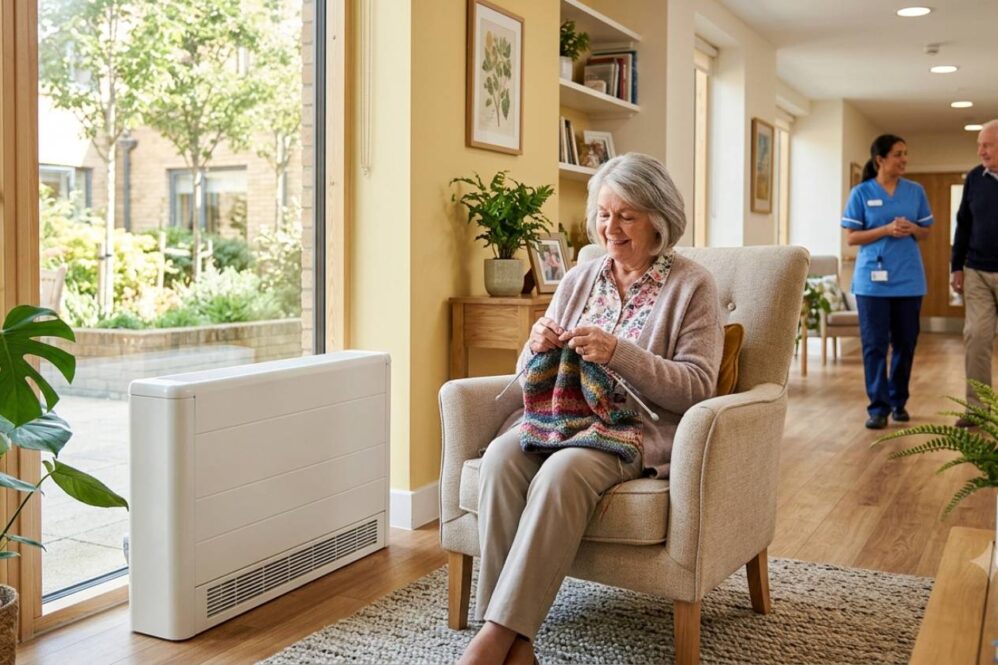
Choosing radiators for schools and care homes requires more than comparing size, style and heat output. Specifiers must consider surface temperature, exposed pipework, hygiene, durability and controls. A well-planned low surface temperature system provides comfortable heating while reducing avoidable contact risks for children, older people and vulnerable building users.
Radiators in schools and care homes must provide reliable warmth without creating an unnecessary safety risk. Children, older residents and people with limited mobility may touch, lean against or fall beside a heat emitter. Conventional radiators can therefore be unsuitable in accessible areas. Low surface temperature radiators use a protective casing to limit contact with hot components while allowing warm air to circulate. When reviewing products from manufacturers such as Stelrad, decision-makers should consider more than appearance. Surface temperature, heat output, hygiene, durability, controls and installation details must all form part of a clear, room-specific heating specification from the outset.
Why LST Radiators Matter in Safety-Critical Buildings
Low surface temperature, or LST, radiators are designed for places where accidental contact with heating equipment is reasonably foreseeable. Their outer casing remains cooler than the internal emitter, reducing the risk of contact burns.
1. Specify a Maximum Surface Temperature
The specification should clearly state the highest permitted temperature for every accessible surface. LST radiators designed for safety-critical environments commonly restrict the outer casing temperature to no more than 43°C.
This requirement should cover the front, sides, top and any accessible heating components. Product information must confirm performance under the intended system temperatures.
2. Protect Pipework and Valves
A cool casing offers incomplete protection if hot pipes or valves remain exposed. The enclosure should conceal accessible flow and return pipework wherever practical.
Specifiers should check:
- Whether the casing extends over valves and connections
- How thermostatic controls can be operated safely
- Whether the design prevents unauthorised access
- How engineers will reach components during maintenance
Controls must remain practical for staff without creating an obvious tampering point.
Match Safety With Heating Performance
An LST radiator must still provide enough heat to keep rooms comfortable without making the heating system work harder. A professional heat-loss calculation should consider insulation, windows, ceiling height, ventilation and target temperature, while radiator output should match the planned flow and return temperatures, especially in low-temperature heating systems. When considering ranges from Stelrad, compare heat output, dimensions, casing design and installation position. Safety should also be supported by strong casings, rounded corners, secure brackets and tamper-resistant fittings, with the wall checked to ensure it can support the radiator’s weight. In busy areas such as corridors and activity rooms, impact resistance is particularly important.
Hygiene and Maintenance Requirements
Cleanability is essential wherever infection control or close personal care is involved.
Choose an Easy-to-Clean Design
Smooth surfaces, accessible cleaning points and an antibacterial paint finish can support routine hygiene procedures. However, an antibacterial finish does not replace regular cleaning.
The casing should allow authorised staff to reach dust traps without difficult dismantling. Facilities teams should also receive clear instructions covering cleaning products, inspection intervals and safe removal.
Plan for Long-Term Access
Maintenance requirements should be considered before installation. Engineers need practical access to valves, emitters and pipe connections without damaging the casing.
Specify replacement parts, warranty terms and inspection responsibilities. A radiator that is difficult to service may be neglected, increasing the risk of leaks, poor performance and avoidable replacement costs.
FAQs
Are LST radiators cool to the touch?
They are designed to keep accessible casing temperatures within a safer limit, but they may still feel warm during operation.
Do LST radiators produce less heat?
Not necessarily. Correctly sized models can deliver the required output while their protective casing limits direct contact with the hotter emitter.
Are radiator covers an acceptable substitute?
Decorative covers may restrict airflow and lack tested temperature control. Purpose-designed LST radiators provide a more dependable safety solution.
Do all rooms need the same radiator specification?
No. Risk levels, room use, occupancy and heat loss should be assessed individually.
Who should approve the final specification?
The heating designer, facilities team, installer and responsible safety personnel should review it against current guidance and project requirements.
In Conclusion
Low surface temperature radiators help schools and care homes combine dependable heating with responsible risk management. A sound specification must set an acceptable surface-temperature limit, conceal hot components and provide enough heat for each room. Secure construction, rounded edges, cleanable finishes and controlled maintenance access are equally important.
Decision-makers should avoid selecting radiators by appearance or dimensions alone. Complete a room-by-room heat-loss assessment, check output at the proposed system temperatures and confirm how valves, pipework and casings will be installed. Relevant safety guidance, building requirements and the needs of occupants should be reviewed by qualified professionals before work begins. The strongest specification is clear, measurable and easy for contractors to follow. By assessing the complete product rather than only its visible cover, schools and care providers can create safer, warmer and more manageable spaces with properly selected LST solutions from Stelrad.