
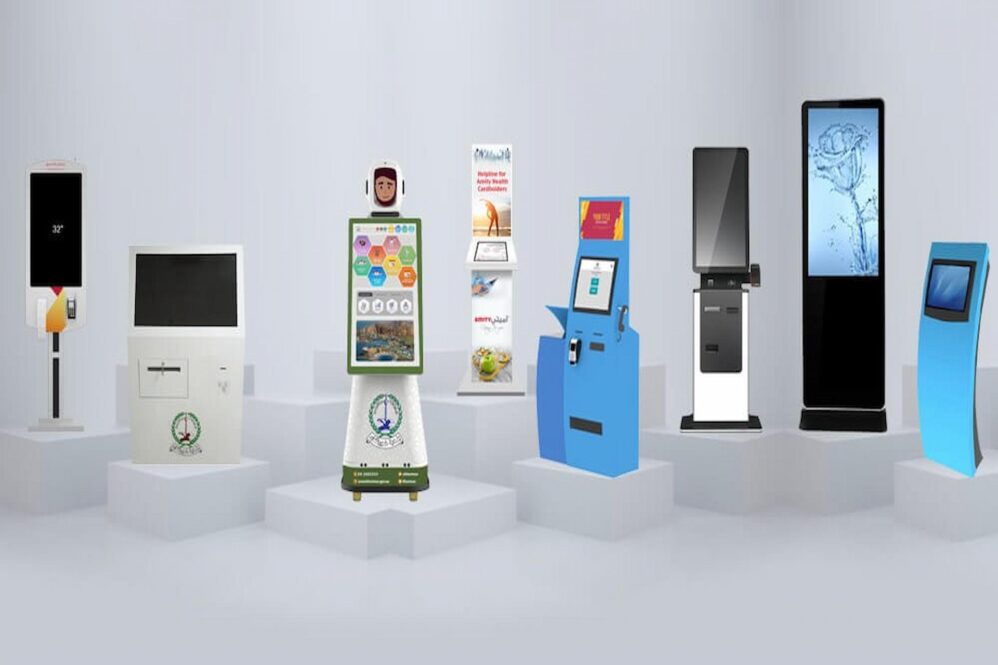
Queues, staffing pressures, and rising customer expectations have pushed retail and hospitality to rethink the in-person experience. Shoppers and guests now move seamlessly between online and in-person touchpoints, and they expect the same ease when they step into a shop, restaurant, or hotel. Increasingly, digital kiosks are becoming the “bridge” that makes it possible to handle routine tasks quickly, present clear choices, and keep the journey consistent across locations.
What is changing is not simply the presence of a screen in a venue. It is the way kiosks are integrated into the space’s flow, connected to back-of-house systems, and managed across multiple sites—an approach reflected in the end-to-end digital experience models used by Evoke. This ensures the experience feels coherent rather than bolted on.
From “another device” to a redesigned customer journey
A modern self-service kiosk is a digital terminal that enables customers to complete tasks independently, ordering food, checking into a hotel, paying, or collecting items, without requiring a staff member for each step.
The bigger shift is how kiosks change the rhythm of service:
- They reduce bottlenecks by providing customers with an alternative route through the journey when the front desk, tills, or counters are busy.
- They improve consistency by standardising key steps, ensuring a similar experience for guests or shoppers across sites.
- They free staff to focus on higher-value work because routine transactions no longer require full attention.
In other words, kiosks are not about removing service. They are about placing staff time where it matters most.
Retail: faster buying, better information, smoother fulfilment
Retail has become an “in-between” world. Many customers combine online browsing with in-store shopping and expect flexibility: click-and-collect, quick payment options, and convenient returns.
Digital kiosks support that reality in practical ways:
1) Self-checkout that reduces friction at the point of purchase
When a shopper is ready to buy, speed matters. Kiosk-driven self-checkout shortens the final step of the journey, particularly in peak hours, and can reduce queue pressure at staffed tills. Retail environments are also seeing demand for self-checkout options as part of the overall experience.
2) “Endless aisle” and range extension without overstocking
A kiosk can offer a broader product range than is physically stocked on the shop floor, helping customers browse, compare, and order items not on display. This supports range-extension strategies that reduce the burden of maintaining inventory at each location.
3) Click & collect, lockers, and returns that fit modern habits
Fulfilment choices increasingly shape retail. Kiosks can work alongside collection and returns workflows—guiding identification, unlocking lockers, and streamlining drop-off steps — so staff can focus on managing exceptions rather than routine handovers.
4) Stronger merchandising through connected screens and data
Retail digital journeys are also being built with multiple touchpoints: signage, product displays, and kiosk interactions that help customers make decisions. When these are planned as one system, the experience can feel like a single guided path rather than separate screens competing for attention.
Hospitality: speed without sacrificing experience
Hospitality has its own pressures: rush periods, staff turnover, order accuracy, and the simple fact that customers dislike waiting when they have already decided what they want. Kiosks directly address those pinch points.
1) Restaurants and quick service: fewer queues, more control for guests
In restaurants—especially high-volume venues—self-service kiosks keep ordering moving, allow customers to choose at their own pace, and reduce the time spent at the counter. This improves throughput and helps staff focus on food quality, service recovery, and hospitality rather than repetitive transactions.
2) Hotels: modernising check-in and reducing front desk pressure
Hotel check-in is a critical “first impression” moment. When the booking experience is fast and digital, a long lobby queue feels like a step backwards. Self-check-in kiosks streamline arrivals, reduce queues, and maintain a consistent experience—especially during busy periods.
A key operational benefit is that front-of-house teams can spend more time on complex needs, including accessibility requests, room issues, itinerary support, and human moments that build loyalty.
3) Consistency across venues and sites
Hospitality brands often operate across multiple locations. Kiosks can help standardise service steps and menu journeys, so customers feel confident in what to expect in each venue.
The real value comes from integration, not just the kiosk
A kiosk is most effective when it is connected to the systems that run the business—POS, kitchen workflows, booking tools, stock, loyalty, and content updates. Otherwise, it becomes an isolated screen that creates extra work.
This is why many deployments now focus on centrally managing the “digital estate”: updating content, monitoring device status, and keeping experiences aligned across locations without relying on manual updates at each venue. Evoke’s site, for example, describes estate-wide content management and monitoring via cloud and operating system tooling designed to push updates and track hardware health.
Integration also affects reliability. If a kiosk is down during a rush, it not only fails but also creates confusion. That is why monitoring and operational support matter as much as the interface design.
Accessibility is no longer optional.
As kiosks become a standard part of service, accessibility must be built in from the start—hardware, software, and user interface working together so people can use the kiosk independently. The European Accessibility Act (EAA) is accelerating this expectation, pushing organisations to design accessibility into the experience rather than treating it as an afterthought.
In practice, this means thinking beyond “nice interface design” and into real usage: screen height, reach ranges, explicit language, timeouts, assisted modes, and inclusive interaction patterns.
How to plan a kiosk experience that customers actually use
The most successful kiosk programmes tend to follow a few disciplined steps:
Start with the pain points and peak moments
Identify where queues form, where staff are most stretched, and where customers abandon the journey. Then decide which tasks kiosks should handle—and which should remain with staff.
Design the flow around people, not features
Kiosks work best when they match natural behaviour: quick steps, clear choices, and a clear next step. Extra features only help if they remove friction or support customer intent.
Make integration a non-negotiable requirement
If the kiosk cannot reliably connect to core systems, the experience will break at the worst moment. Integration should be planned early, including how updates and monitoring will work across sites.
Plan for deployment and support
Multi-site rollouts require a repeatable approach: installation, training, troubleshooting, and continuous improvement. Strong programmes treat implementation as an operational change, not a one-off technology purchase.
Conclusion
Digital kiosks are transforming retail and hospitality by reshaping the customer journey where it matters most: at decision points, queues, checkouts, and arrivals. In retail, they support faster purchases, flexible fulfilment, and more informed shopping. In hospitality, they reduce bottlenecks and enable teams to focus on genuine service. The strongest results come when kiosks are integrated into wider systems, centrally managed, and designed for accessibility from day one.
In many organisations, this shift is delivered through an end-to-end approach spanning design, manufacturing, implementation, and ongoing service, as described by Evoke Creative across its kiosk, hospitality, retail, and technology pages.